Tuesday, April 21, 2009
Walk the Line

Monday, March 30, 2009
Dipity Timeline
Dipity
Sunday, March 29, 2009
IR # 10 (Prompt 3, Chapter 10)
Over the course of the journey, Miguel Littin changed a lot. When he departed for Chile in the first chapter, he was very apprehensive and he was very scared of the troubles to come. As the trip progressed, he became more comfortable with being clandestine, and therefore he let his disguise down a little. Later in the novel, he reveals to more and more people who he really is. I think that two months was too long of a time to stay in Chile because it made him want to break his new Uruguayan identity. Having the people and places surround him that had once been a part of him was too much for him to forget. By the end of the chapter, he is very relaxed and finds entertainment in the other passenger trying to do what they had done. Surprisingly, Miguel was never caught and I think the situations he encountered really helped him because he was able to show his intelligence and utilize it quickly to basically "out-smart" the police. I was happy at the end to know that Miguel left all his suits and disguises in Chile so that he could revert back to who he really is. It was important that he returned to his old self and not let the new identity overtake him. It was very interesting to see Miguel's transformation and he is an inspiration to the world even today.
IR #9 (Prompt 15, Chapter 9)

This chapter was very inspiring and very hopeful. Miguel heads into Argentina to shoot with the Chilean crew for the first time. After they shoot, they realize that it is after curfew and they must find somewhere to stay immediately. They end up driving to the nearest dirt road and they follow it until they reach a small house. As they pulled up, Miguel realizes that it was his childhood house and his mother still lived there. At the start of his journey, he was forbidden to see his mother because he would endanger her, but this was an exception according to him. At first, she did not recognize him, but after he let her in on his new identity, she was ecstatic. They talked all night and early the next morning she took Littin outside where he saw a small hut. It was an exact replica of Miguel's study house where he lived the day of the exile. Miguel says "I couldn't be sure whether my mother had created that painstaking reconstruction so that I would not miss my former home if I were to return one day, or whether it was left as to remember me by, should I die in exile" (Marquez 101).
I chose the picture above because I thought it really summed up the chapter and more so his mother's dream of his return. She never lost hope that one day her son would return again, and her optimistic attitude was very beneficial and her dreams became a reality. I think the girl in the picture is reaching for hope. The balloon is the hope that she is trying to hold on to just like Miguel's mother did for twelve long and painful years. On the wall in the picture, it says there is always hope, and that was the attitude of Miguel' mother.
IR #8 (Prompt 7, Chapter 8)
At the beginning of the book, Miguel and Elena had difficulty getting through customs at the airport. After they finally got through, Miguel questioned his intentions for the journey and wanted to scream out his real name. I made the prediction that the journey would be very dangerous to begin with. I also said that as the trip progresses, the chance of getting caught will increase. Finally I believed that the police in Chile would suspect them after awhile and their disguises would begin to peel off. My predictions were correct and this chapter proved that. They have already stayed in Chile longer than they originally intended so they are going to be more recognized by police. Also, it was vital that the crew and Miguel always carried their identification, but the crew was caught without it and was sent home. Miguel needs to wrap up this adventure before he, too, joins his crew. I also think that Littin is becoming more comfortable in his old Chilean environment, and it is making him forget his disguise. When he met with Eloisa, he told her who he really was and his mission. He also reverted back to his old laugh just to prove that it was indeed he. I am getting nervous for him, and I think that after that scare, it is time to shoot the ending and get on a flight back to Europe.
IR #7 (Prompt 2, Chapter 7)
IR #6 (Prompt 1, Chapter 6)

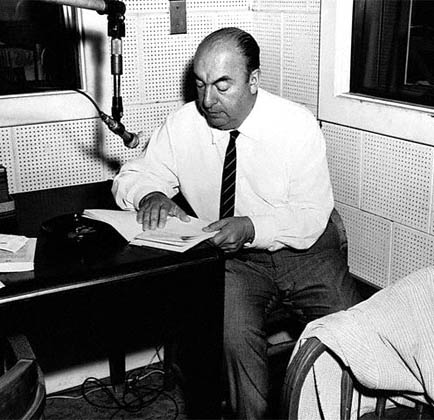
Although the chapter was significant to Littin and his past, I disliked it. I felt like most parts if not the entire entire chapter was unnecessary and it lost focus on Miguel's journey through Valparaiso. They discuss the coup and how Allende spent his last days. Littin then discusses Pablo's poetry. Miguel describes the cults in Chile today that focus on Neruda and Allende. The chapter also mentions that many people visit their graves and pay their respects to the men that fought for their freedom. I thought the chapter was interesting when it described their lives; however it really was not crucial to the story line.
IR #5 (Prompt 4, Chapter 5)
 Sebastian Acevedo. It was at that plaza, which he revolted against the torture of his two children. They were arrested for the possession of firearms and were sentenced to torture. Sebastian sat outside the cathedral along with hundreds of spectators and covered himself in gasoline. He then threatened the police that he would set himself on fire if they do not let his children free. He told the crowd and the police that if anyone crossed the yellow line he would immediately ignite himself. Losing patience in the riots, a police officer stepped over the line and Sebastian set himself on fire pictured to the left. He burned for seven long hours until he was finally taken to the hospital where he asked to speak to his twenty-year old daughter. The doctors would not allow her to see the grotesque scene so she only spoke to him through the intercom. After his death, they let his children free and Concepcion is secretly called Plaza Sebastian Acevedo.
This whole story seemed unimaginable to me and I had a really hard time reading the description. For things to get that bad where people are setting themselves on fire is ridiculous and the police, at that point need, to be stopped. To die in such a horrifying way is inhuman and completely unethical. How can the police allow an innocent man to set himself on fire? Even now I still cannot come to terms with how shocked and disgusted that story made me.
IR #4 (Prompt 5, Chapter 4)
The part of this chapter that moved me was when he was talking about all the hotels they have stayed at during the journey thus far. He emphasizes that they must stay in five-star hotels because they would be questioned in lower ones because of their dress and status. The problem with staying in five-star hotels is that the police guard them all the time. Miguel explains how they were blessed with good luck in two almost fatal situations. The one specific situation that moved me was when they stayed at the Hotel Carrera. Both Miguel and another couple checked in and stayed in neighboring rooms, but the couple had different intentions during their stays. While Miguel was trying to acclimate himself to life back in Chile, the other couple was setting up a tripod on which they mounted a delayed firing Bazooka that they aimed at Pinochet's office. Miguel checked out the next morning, and that day, the couple set the gun off, but the tripod gave out from the force of the gun and collapsed, causing Miguel's room to be blown up instead. As Miguel depicted this horrific incident, I was really taken back. The whole idea of Littin being in that room previously shocked me and he was very very fortunate.
IR #3 (Prompt 14, Chapter 3)
"It wasn't until that moment that I realized how long and devastating the years of exile have been. Not just for those of us who left--as I has thought until then--but also for the ones who had stayed" (Marquez 33).
This quotation was basically why Miguel Littin entered Chile despite the exile list. His goal was to reveal the true Chile behind closed doors. He wanted to expose the corrupt government and carabinero (Chilean police). After Ely was unable to recognize him, he had the revelation that he really was a new person. After this revelation, he began to question Ely and he soon realized how horrible it was to be in Chile after the coup d’état in 1973. Littin believed that Chileans would be the same as before the exile, but he discovered that they were far from it, and interestingly enough, this intrigued him and he switched gears on his movie and began to shoot along the lines of the people and the "unexiled". After this quotation, Miguel shapes the rest of his stay in Chile around these new factors. This point in the book was very influential to the rest of the book because it drove Miguel to his findings about the new Chilean life and how much his people struggled. The whole situation reminded me of Che Guevara in The Motorcycle Diaries because Ernesto set out to medically treat patients, who could not get treatment, but he soon discovered how corrupt the government was and also how poverty-stricken his country was.
Tuesday, March 24, 2009
Write Your Own Do Now

Che matured a lot through his journey especially after he was exposed to politics. Because Che was so young, do you think he was more susceptible to the influences of world around him? Had he been more experienced, do you think the outcome of his life would have been different?
I chose this do now because over the course of his journey, I feel like Che let the people he encountered and the places he went influence his ideals and identity. I think that had he been more exposed to politics or poverty prior he would not have been so easily manipulated.
Sunday, March 22, 2009
IR #2 (Prompt 6, Chapter 2)
If I were to make predictions about Miguel and Elena's trip to come it would probably be very risky. I think that they are going to be put in pressured situations where they are pushed to the limits of their disguises. I also think that officers or government officials will be on to them after awhile and that they might get caught. Elena seems much more stable with the whole situation than Miguel, so I think she will be the safer one. In this chapter, Miguel says "I forgot my clandestine situation and returned for a moment to being myself. I had an irrational impulse to identify myself, to shout out my name, to tell the world it was my right to be home" (Marquez 18). This frightens me a little because he has only been in Chile a few hours and he already is returning to his old recognizable self. I think this will be his downfall and I believe his whole mission is too hard for him to handle.
IR #1 (Prompt 13, Chapter 1)
 The first chapter of Clandestine in Chile jumped right into the life of a film director exiled from his home of Chile ten years before. Along with many others, Miguel Littin was exiled by Augusto Pinochet, the dictator at the time. After ten long years of exile, Pinochet issued a list of exiles who were allowed to re-enter their home country, but Miguel was not one of them. Soon after, Pinochet issued a second list of names that were forbidden to ever visit Chile again, and sadly, Miguel's name was on that list. Having seen the list, Littin decided to fight back against the Chilean government in an unthinkable way. He decided to go undercover and enter Chile with a fake passport and papers. His plan was to have three European film crews tape the horrific world that Chile has become. When Chapter one begins, Miguel is in Paris and begins his two year transformation into a Uruguayan business man. He goes to many different doctors and specialists to physically and mentally change who he was. He gets a haircut, glasses, new clothes, a new accent, and a new childhood. He also is given a wife, Elena that would travel with him for safety. After two years, in 1985, even his family could not recognize him.
I honestly think that Miguel's idea to go to Chile was extremely dangerous and risky. If I could give him advice before he left it would be to never travel alone, and to always fit in with the crowd. At this point in time in Chile, police were watching every corner of Chile and they checked papers of people all the time. I think Miguel needs to also watch who he talks to and formulate an escape plan if worse comes to worse. I would also offer positive advice and say discover what no one has and be a savior to the home you love.
Friday, March 20, 2009
Intro to Independent Reading
Gabriel Garcia Marquez
We had to choose an independent reading book that is related to the topics and/or cultures we are studying this marking period (Latin America). It may be related to the culture(s) by author, topic, content, religion/belief system, history, area of the world, themes, etc.
Could be Fiction (Traditional Fiction, Fantasy, Science-Fiction, Realistic Fiction, Historical Fiction), a Collection of Poems or Plays, or it may be Non-Fiction (Informational, Biographical, Autobiographical, Memoir).
While reading this book, we must create a blog that will document our thoughts.
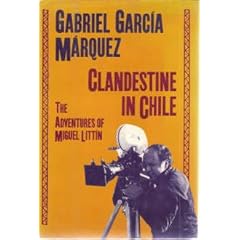
Clandestine in Chile is a novel that Gabriel Garcia Marquez wrote after a long interview with film director, Miguel Littin. Miquel was exiled from his homeland of Chile for 12 years and after 10 years in exile, a list was published of people allowed to return and when Miguel was not on the list, he became very upset. Soon after, another list was published that had a list of names that could not return to Chile and there was Littin's name. He decided to go undercover and make a documentary about the government and living conditions in Chile. For two years, he worked to change his identity and with the help of three European film crews, they departed for Chile. It would turn out to be a dangerous journey that risks many lives including Miguel's.

Columbia and Venezuela

"But despite his words, I now knew...I knew that when the great guiding spirit cleaves humanity into two antagonistic halves, I would be with the people." (Guevara 164)
"My sin is greater because I, more astute and with greater experience, call it what you like, will die knowing that my sacrifice stems only from an inflexibility symbolizing our rotten civilization, which is crumbling." (Guevara 164)
"I steel my body, ready to battle, and prepare myself to be a sacred space within the bestial howl of the triumphant proletariat can resound with new energy and new hope." (Guevara 165)
These quotations are all very high spirited and show a new side to Che. I think he has all the intentions in the world to save the people he loves and the country he lives for. I think he wants to better humanity and change the poverty stricken nation he has dealt with for so long. I think he shows how dedicated he is to fighting this battle and shows that he will die trying to save humanity. With this energy and spirit, anything is possible. The picture I chose is of two poverty stricken children. I chose this picture because it is those faces that drove Che to sacrifice himself for the people. They were his driving force and it is those faces that he was willing to die for. It is also those people who found hope in Che and they finally believed change was coming.
Thursday, March 12, 2009
Theme #6 Intro
2. Ernesto Guevara thrived as an amiably audacious doctor, but he quickly lost sight and fell in to the complex world of Che. His brief encounter with militaristic power caused him to become a belligerent and malicious executioner whose intentions became questionable but nonetheless his original empathetic impact was vast.
Tuesday, March 10, 2009
Peru Diction Quiz
Monday, March 9, 2009
Essential Question #2
Wednesday, March 4, 2009
Chile
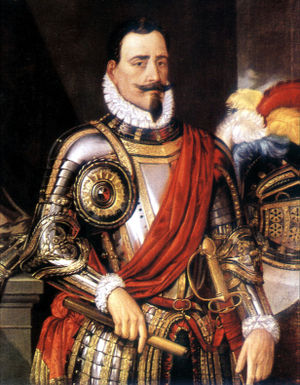
This revelation about Valdivia really shaped Che in later life. At first, Che seemed okay with being second to Fidel, but soon, he craved that total authority. At the end of the page, he also says, He belonged to that special class of men the species produces every so often, in whom a craving for limitless power is so extreme that any suffering to achieve seems natural." I think Che really internalized Valdivia's character, and tried to be that "special class". I think the fact of this omnipotent ruler shaped Che's political ideals, and caused Che to want to be that man.Valdivia was a conquistador that ended up becoming the first governor of Chile. It is kind of ironic how Che begins as an adventurer and later becomes a political symbol.
Friday, February 27, 2009
Thursday, February 26, 2009
Apples to Apples
Tuesday, February 24, 2009
Argentina
1. The first passage I chose was when Ernesto had fallen ill. He says "My green eyes refused to sleep and in them, a pair of green spots swirled, representing the world I had left behind me and mocking the so-called liberation I sought. The harnessed their image to my extraordinary flight across the lands and seas of the world" (Guevara 40).
This quotation really stuck out to me when I was reading and I think Ernesto's voice really surfaces here. The diction is very well done. He uses the words harnessed, extraordinary, liberation, flight. All these words sound so positive and they all infer freedom. Readers can sense his excitement and his crave for change. Also, his imagery was powerful. He describes the pair of green spots as they swirl through his eyes. The detail and imagery gave the passage a sense of unreality in a way. His tone, like I said, was positive. I think this quotation was almost his last words to his old life. He sees the world spinning before his sleepless eyes, yet instead of embracing the journey into the unknown with fear, he is taking it with all it has to offer and he is not afraid. He explains that he is leaving his old life behind as he searches for liberation and freedom.
2. The second passage I chose was when Ernesto was in the hospital and his friend Alberto takes a picture of him. Ernesto says "Alberto photographed me in my hospital gear. I made an impressive spectacle: gaunt, flushed, enormous eyes and a ridiculous beard whose shape didn't change much in all the months I wore it. It's a pity the photograph wasn't a good one; it was an acknowledgment of our changed circumstances and the horizons we were seeking, free at last from "civilization"" (Guevara 41).
This was a very good example of Ernesto's voice. The diction was very strong when he describes his status. He is gaunt, flushed... ect. Also, his details and imagery are very good too. He describes his new, free look with his new beard. This beard is really what makes the face of Che. Everyone knows that face and this passage was the start of it. Also, I thought it was interesting how he put quotation marks on civilization. This was interesting syntax and I think he used it to emphasize the point that he was for change.
Friday, February 20, 2009
Introduction Theme #5
Thursday, February 19, 2009
Essential Question
Tuesday, February 17, 2009
Introduction
Everyone craves adventure
The freedom
the unknown
Hoping to learn a great deal
About life
About you
Experiencing the beauties of the world
around us
in us
Trying to reach the unreachable
whatever
where ever
Lost in life
trying to find strong ground
facing the realities
the triumphs
but the search never ends
secluded by dreams and aspirations
There is nothing lonelier than adventure